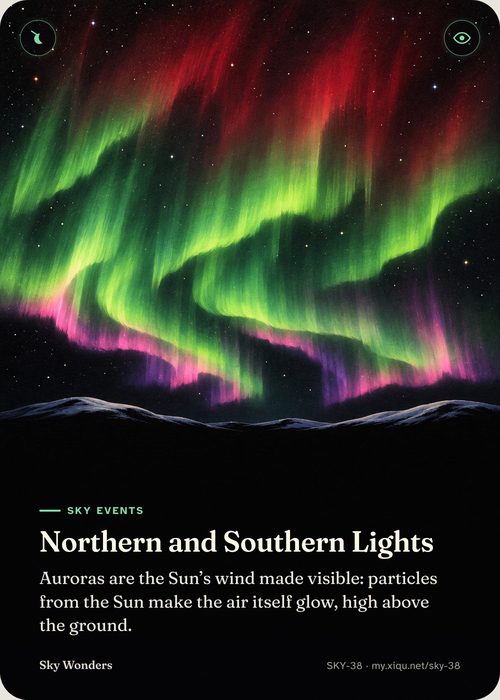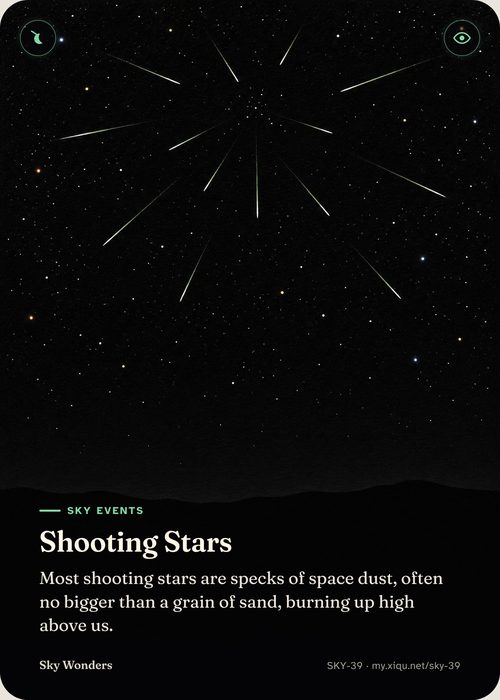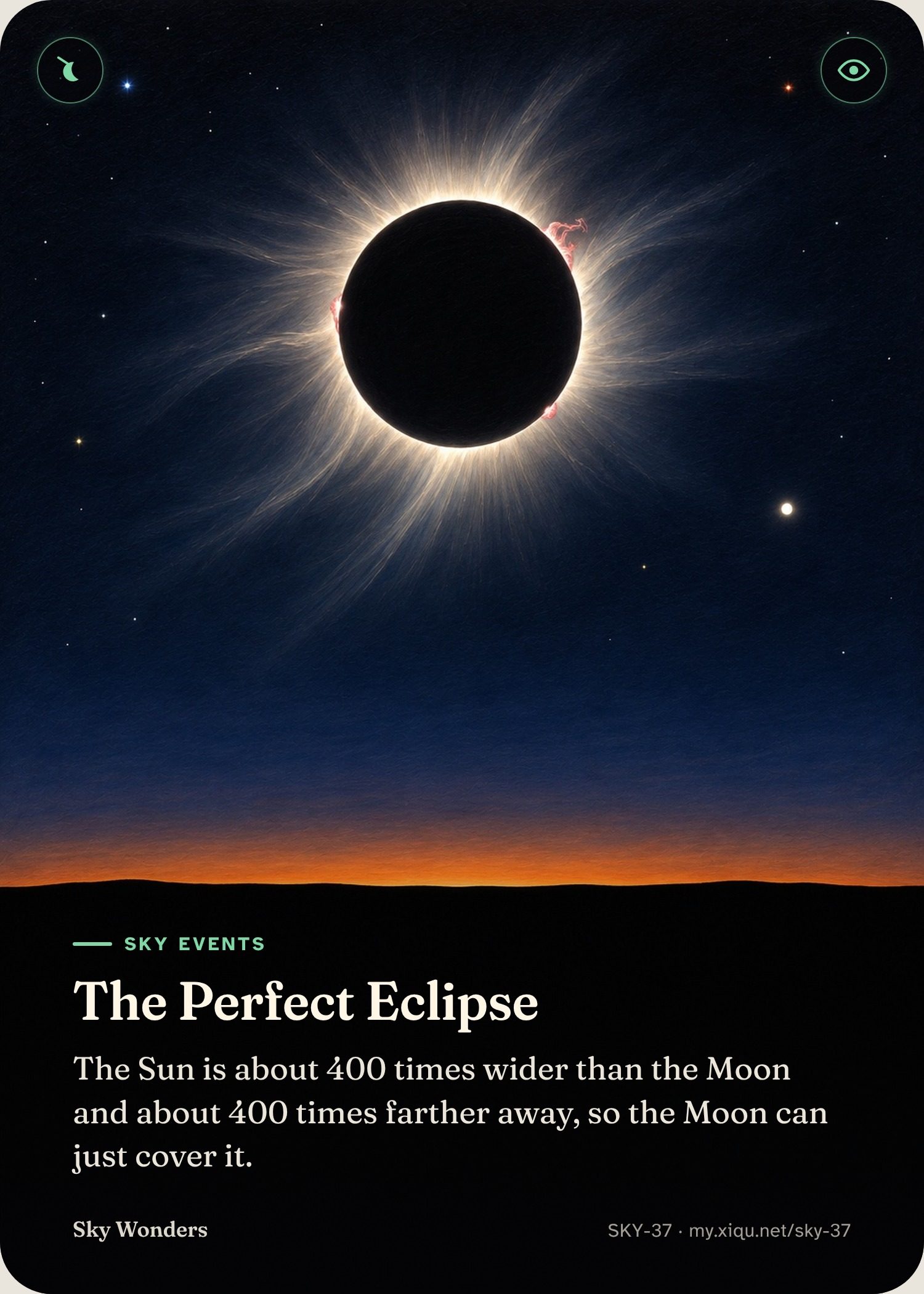
The Perfect Eclipse
The Sun is about 400 times wider than the Moon and about 400 times farther away, so the Moon can just cover it.
What’s going on
That coincidence makes total solar eclipses possible. For a few minutes the Moon hides the Sun’s bright face, and its faint outer atmosphere, the corona, appears as pearly streamers. The Moon’s orbit is slightly oval, so sometimes it looks a little too small and leaves a ring of Sun: an annular eclipse. Laser measurements show the Moon drifting about 3.8 centimetres farther from Earth every year.
Myth
It is safe to look at the Sun once the Moon covers most of it.
Fact
Only during totality is it safe; at every other moment use proper eclipse glasses.
Learn more
OpenStax, Astronomy 2e, §4.6–4.7; NASA Science, “Eclipse Safety” (science.nasa.gov/eclipses/safety).
Look up tonight
Total solar eclipses happen somewhere on Earth about every 18 months. On 2 August 2027 one crosses parts of Spain, North Africa and the Middle East. Use proper eclipse glasses at every moment except totality.
Play Myth or Fact? Read out either the sentence on the card or the myth above. Can everyone tell which is true?
- Tap the Share button in your browser.
- Scroll down and choose Add to Home Screen.