Shooting Stars
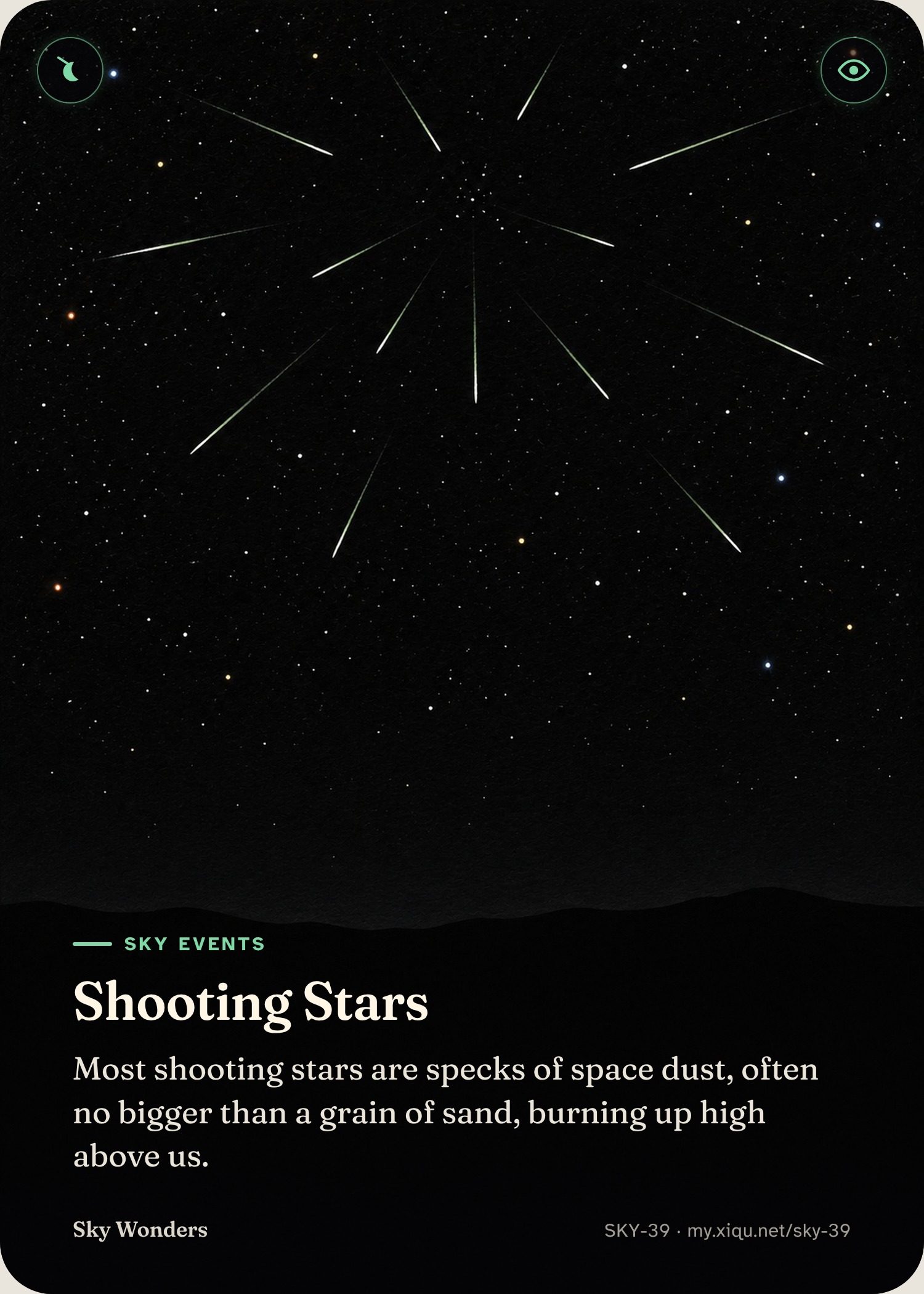
Most shooting stars are specks of space dust, often no bigger than a grain of sand, burning up high above us.
What’s going on
Bits of space dust hit our atmosphere at tens of kilometres per second. The air in front of each speck is squeezed and heated so violently that it vaporises in a brief streak of light, roughly 80 to 120 kilometres up. In a meteor shower, Earth ploughs through a trail of dust left by a comet. The Perseids each August come from Comet Swift–Tuttle, and their streaks all seem to fan out from one point.
Myth
Shooting stars are stars falling from the sky.
Fact
Real stars are enormous and far away; a meteor is a speck of dust in our own air.
Learn more
NASA Science, “Meteor Showers”; NASA Earth Observatory, “Meteors Great and Small”.
Look up tonight
Watch during a meteor shower, such as the Perseids in mid-August or the Geminids in mid-December. Lie back somewhere dark and take in a wide patch of sky.
Play Myth or Fact? Read out either the sentence on the card or the myth above. Can everyone tell which is true?
- Tap the Share button in your browser.
- Scroll down and choose Add to Home Screen.